m e d i o s i g l o

[ 12:35 Sunday 24 October 2021 – MV Orlando, Thames estuary ]

I’m sitting on the top deck of Orlando under a clear blue sky, swinging slowly in the wide open estuary, with the autumn sun on my face. To the north, the windswept expanse of Rainham Marshes fills the landscape behind a sweeping bend in the river, familiar to me from many explorations by foot and bike. Every few minutes a high speed train whistles past behind the marshes, sending clouds of birds rising from the wetlands.

To the south, the muddy bank is lined with waste processing plants and cement works, with the spire of Erith church peeking above piles of twisted metal upriver. The ghostly sentinels of Canary Wharf and the City shimmer on the distant western horizon, reminders of the great city at their feet.

We arrived yesterday evening in the final rays of sun and lowered our anchor rattling into the black sticky mud, following an exhilarating run down from St Katharine Docks, skimming over the water at twenty-five knots. With the engines spent, the only sound was the sucking and slapping of the fierce ebb tide pulling at the hull, drawing the anchor chain taut like a violin string and painting a fan of tangled water behind the stern.
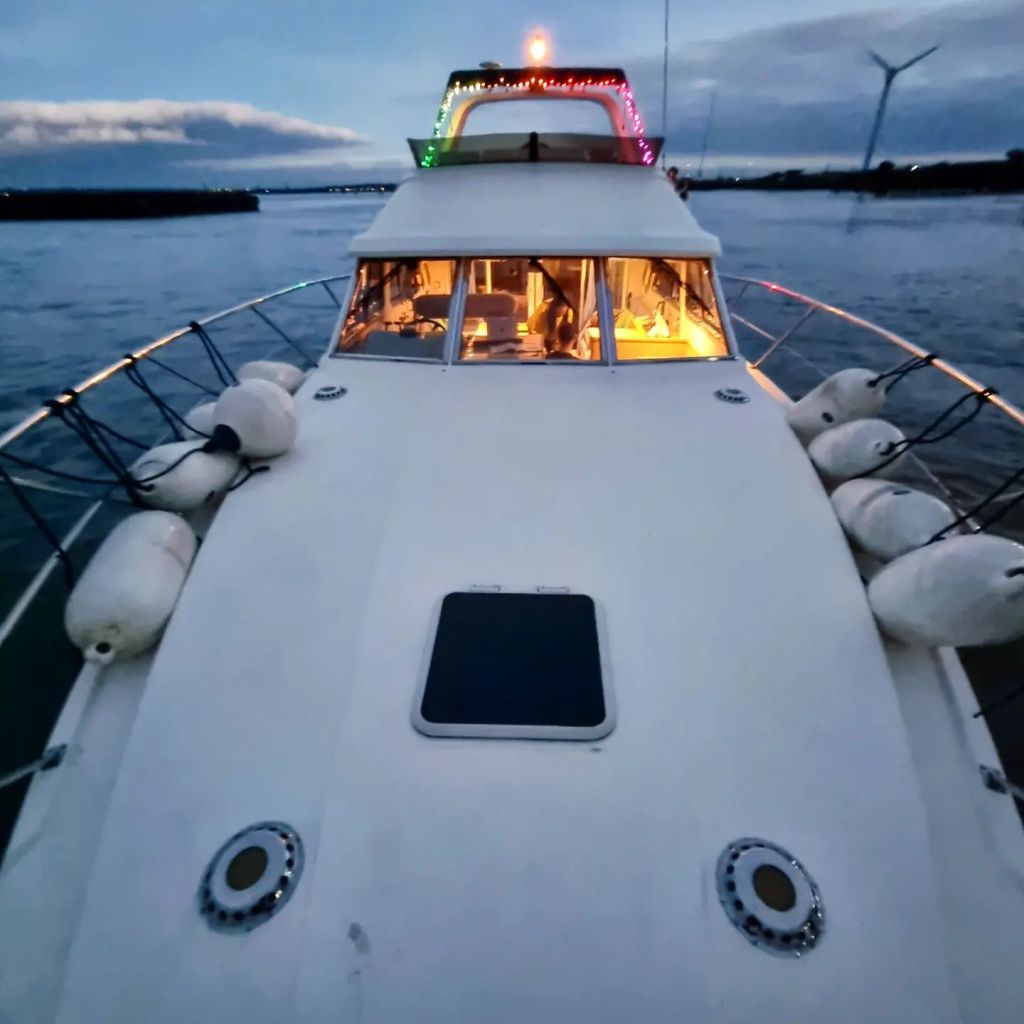
Orlando at anchor, Thames estuary

We planned to go further, to the mouth of the Medway, and anchor in the desolate mudlands of Stangate Creek. But a fault with the fuel gauges left us uncertain what remained in the tanks, so we erred on the side of caution and stopped here.

Ever since buying the boat in the spring and bringing it down to London, I’ve been yearning to spend a night at anchor on the estuary, entirely off-grid. This first experiment has been a thrill. Alejandro and I cooked dinner on the gas hob: sauteed haddock loin, cavolo nero and mashed sweet potatoes with spring onions. We played cards in the saloon as the boat swung on the turning tide. It feels as though we’re cut off from the world, completely self-sufficient.

Half an hour after curling up in bed there was a scare when suddenly the boat began pitching and rolling crazily, sending cups and bottles crashing to the floor. I was awake in an instant and scrambled out to the deck expecting to find a giant ship passing. However the river was deserted and after a few minutes the waves subsided, their cause remaining a mystery. We went back to sleep and the night saw no further disturbances.

Alejandro and I spent the final week of September packing up the house in Port D’Es Canonge. With a heavy heart I took final swims from my favourite places. On the thirtieth, my final day as a legal visitor in Spain under the post-Brexit regulations, we flew to London. There was still no word from the Spanish Consulate regarding my visa, so we departed Mallorca with no idea when we’d be returning.
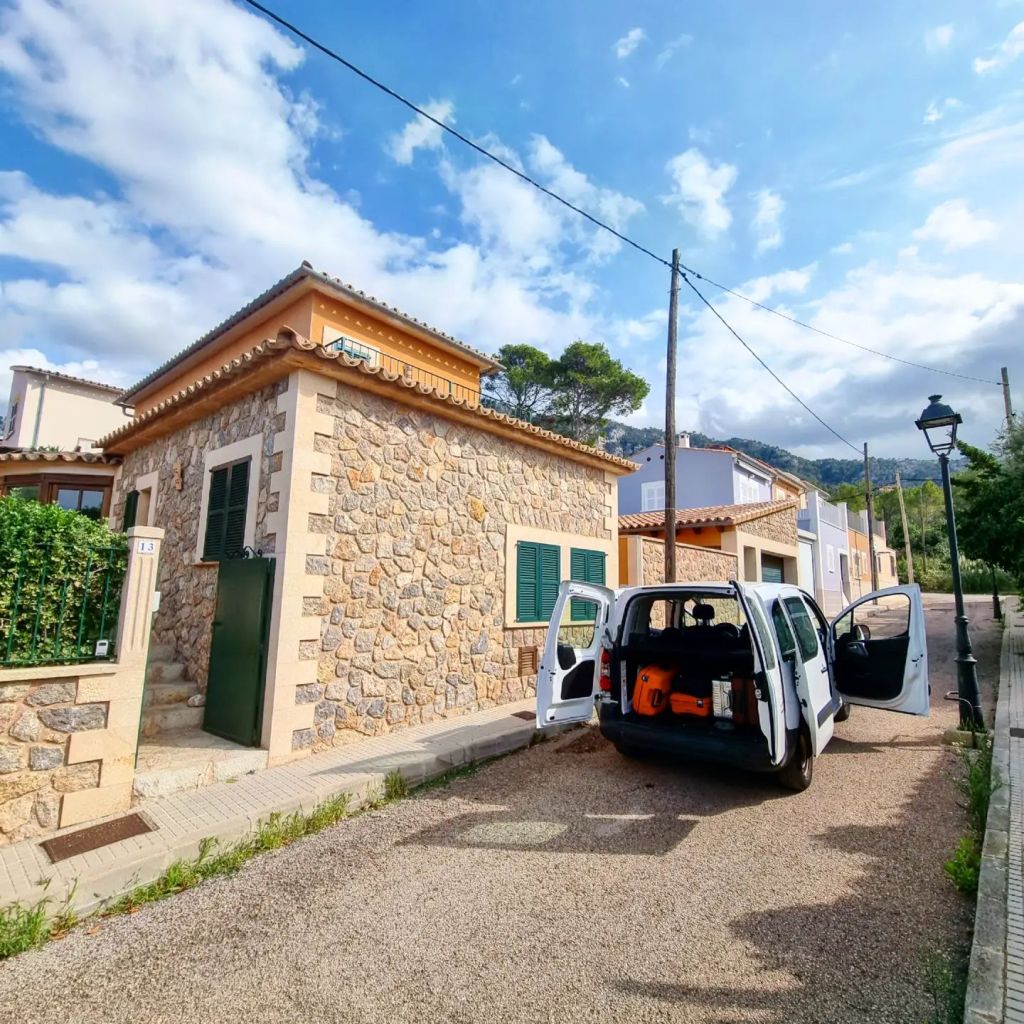
Packing up the house, Port D’Es Canonge

Despite my melancholy at leaving Mallorca, it’s been a pleasure spending October in Britain. The first week was a riot of meetings with The Trampery and catching up with friends. On the fourth a message finally arrived from the Spanish Consulate: my entrepreneur visa was granted! Alejandro and I cracked open a bottle of champagne to celebrate and we stared making plans for the winter in Mallorca.

From London I got the train to Cornwall and spent a week with my family. The weather was glorious. Each day was filled with coastal hikes and swims. One especially sublime morning my parents donned their wetsuits and joined me for a swim on the Roseland peninsular. Having been without a piano since selling mine in June, I greedily ploughed through JS Bach’s Goldberg Variations on Mum and Dad’s, greatly relieved to find my technique returning after a couple of days. Alejandro joined me in Cornwall and we spent a night with Anna and Adam. Then Mum organised a magnificent dinner for all of us, the first time we’d been together around a table since before the pandemic.
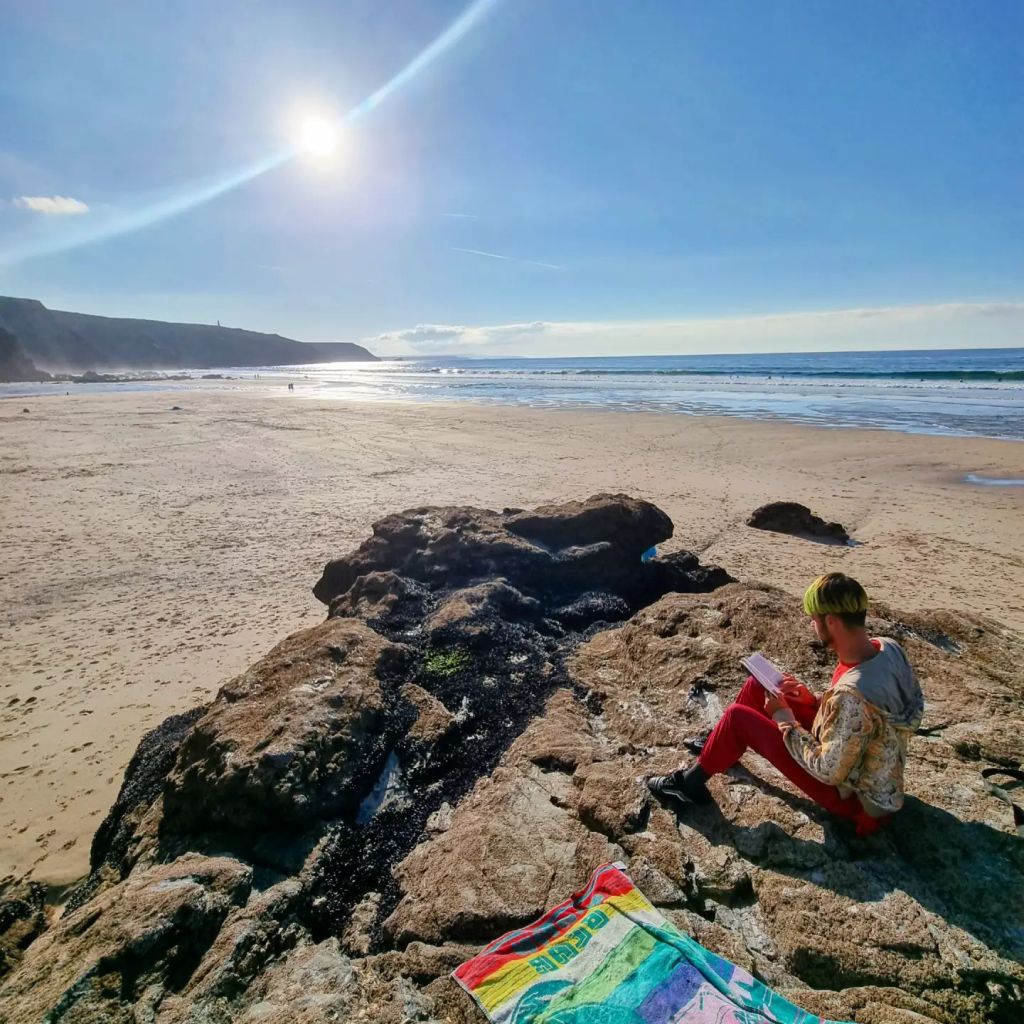
Low tide at Porthtowan, Cornwall

After Cornwall our next stop was a three-days electronic music festival in Sheffield, the first time I’d been in an enclosed space with so many people since March 2019. Once I’d got used to the crowd, I loved it. The artist roster was superb and I’ve missed dancing like crazy. From Sheffield we returned to London, where we remain until flying back to Mallorca on the fourth of November.
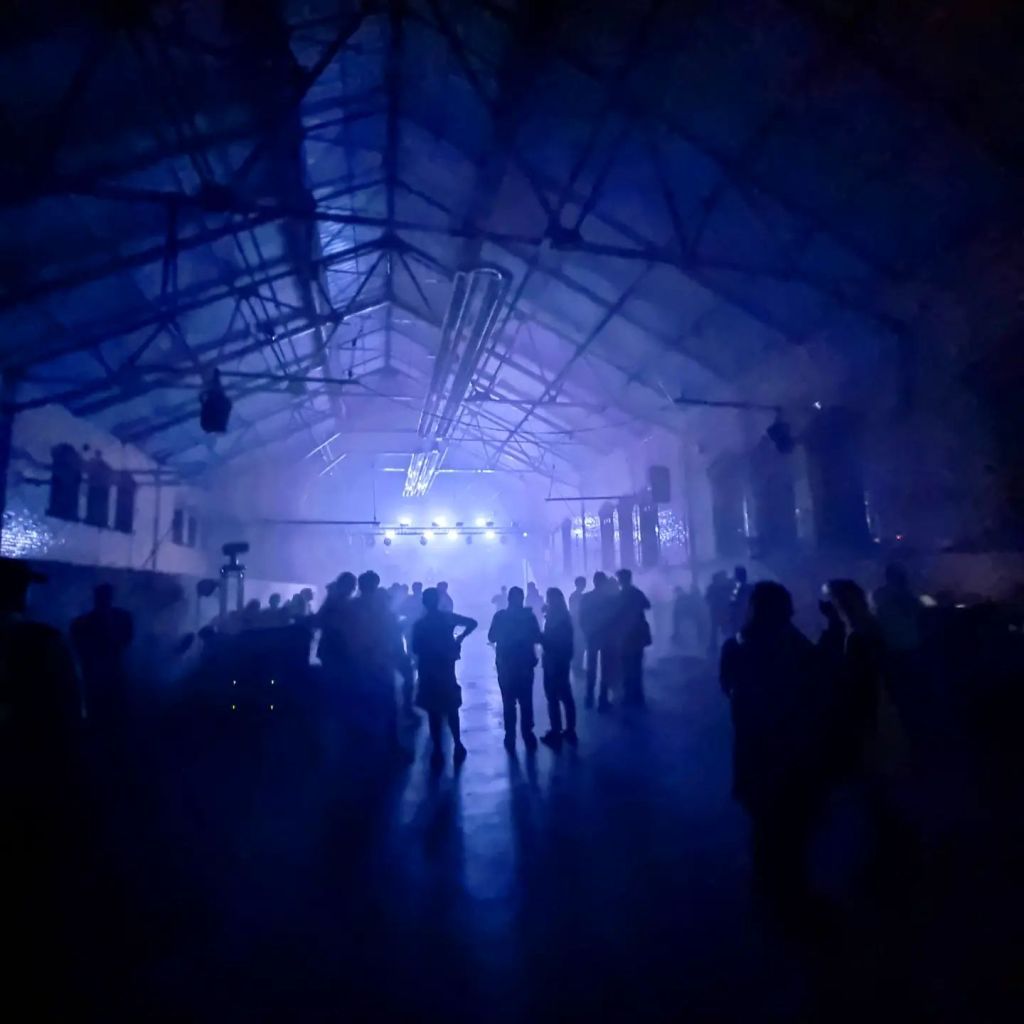
Opening night of No Bounds festival, Sheffield

This month has been our first extended period living on board Orlando together. Ever since we decided to get a boat as our London base, it’s been a bit of a gamble how we’d find it in practice. Would we start feeling claustrophobic after a few days? Would it be unbearably cold in the winter?

To my relief we both love it, to the point where we could probably live aboard indefinitely. There’s enough space for the two of us to potter around doing our own stuff without tripping over each other. Whenever the sun is shining I take my laptop up to the flybridge and work there. On frosty nights the hot air system keeps the cabin toasty.
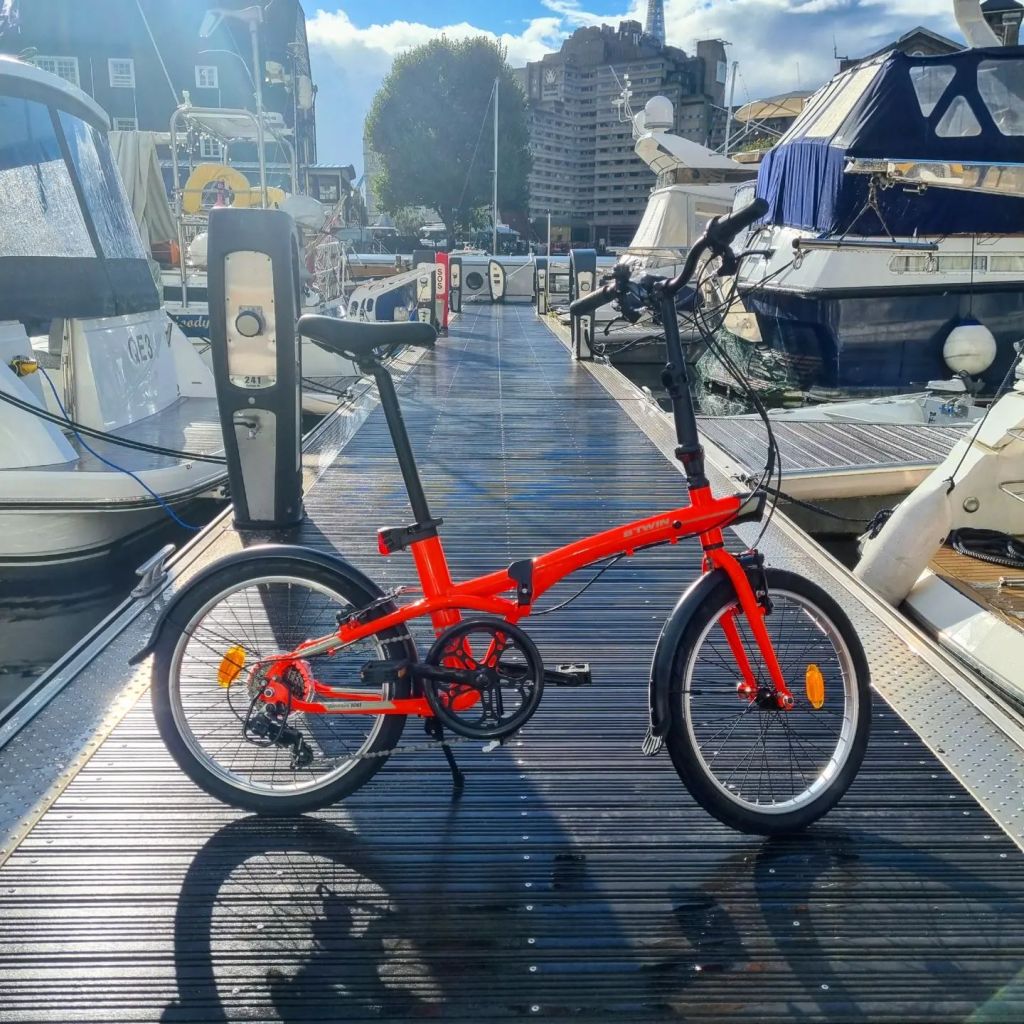
My new folding bike on the pontoon, St Katharine Docks

There’s something about the boat’s constant gentle movements as it shifts on its mooring that I find particularly conducive to peaceful sleep. I love being tucked up in bed when the rain is pattering on the foredeck above our heads. We’re still getting used to being so centrally located in London. Museums and galleries that were an hour’s travel from Hackney Wick are now within walking distance. Meanwhile I’ve bought a little folding bike so I can zip back and forth to meetings.

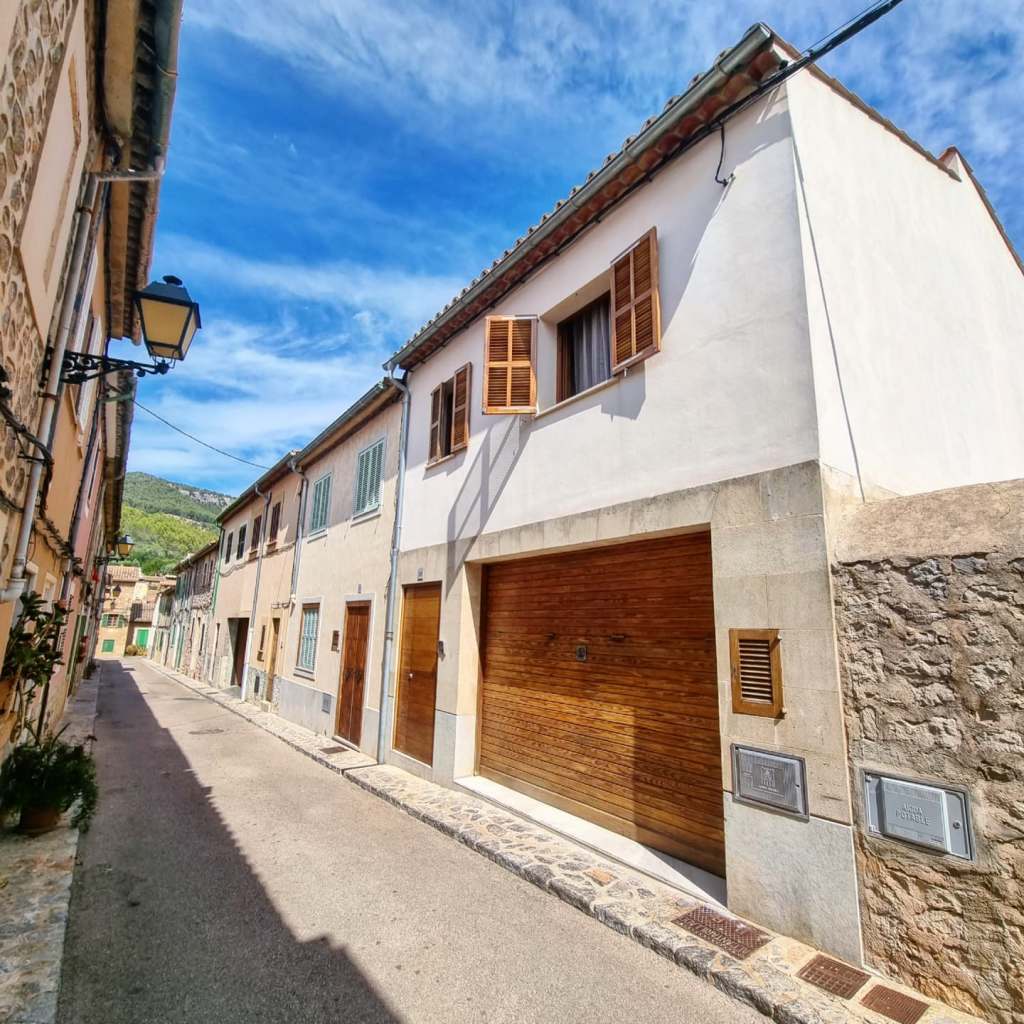
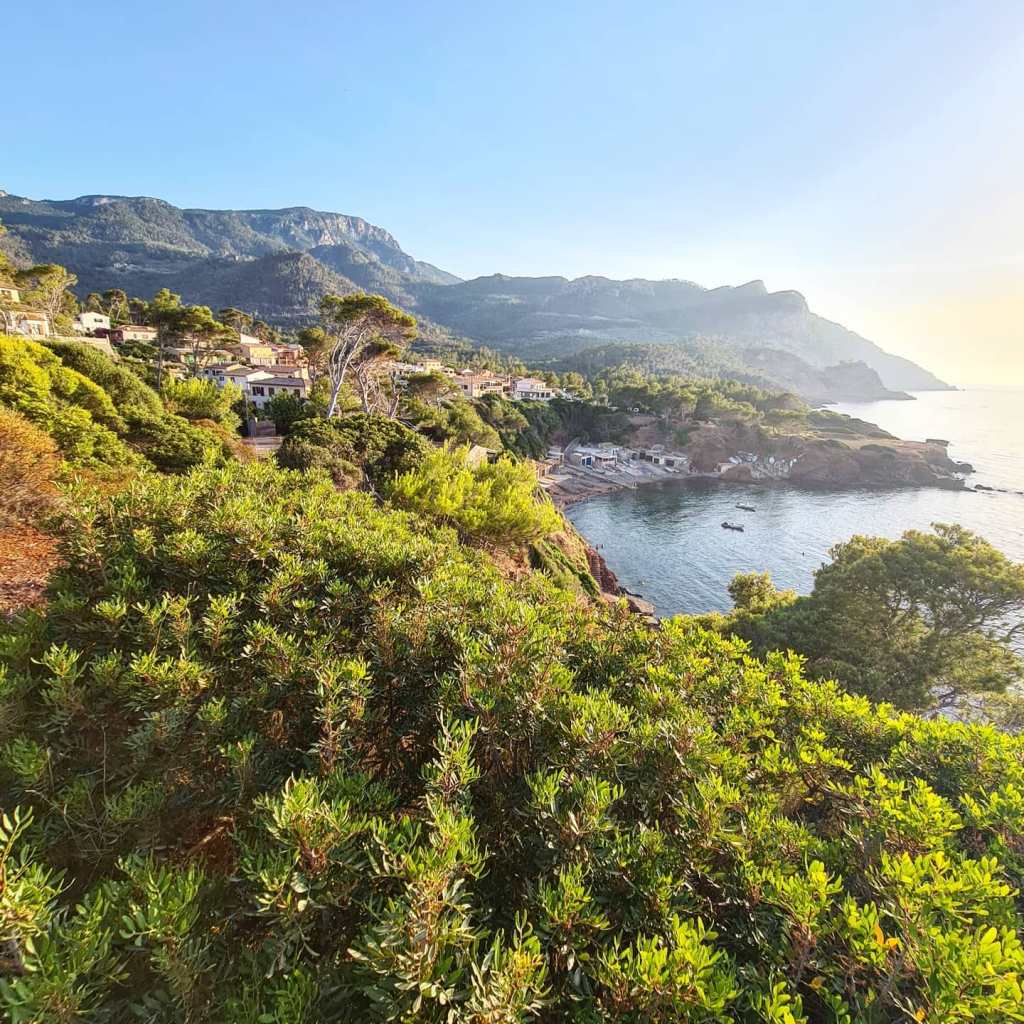
On the fourteenth of September I celebrated my fiftieth birthday with Alejandro in the town of Soller, on the north coast of Mallorca. I feel nothing but gratitude for the life I’ve been granted.

: c :
v e i n t e a Ñ o s

[ 10:52 Friday 20 August 2021 – Esporles, Mallorca ]

Exactly twenty years ago today, I packed up my home in London and moved to the island of Stromboli. I planned on staying two months but ended up living there two years.

During that period on Stromboli I evolved the most productive working routine I’ve discovered to date. Each day comprised alternating periods of two-to-three hours’ intensive working, punctuated by half-hour periods swimming in the sea (in summer) or walking (in winter). I found that this rhythm enabled me to get a lot of work done, remaining consistently creative and without feeling tired at the end of the day. Coming back to London in 2003 I found it painful making the transition to working a regular eight-hour day in the office again.

A few days after arriving in Port D’Es Canonge last month, I realised that I’d automatically switched back into my Stromboli working pattern. The main difference now is that my routine includes several video calls a day, which didn’t exist in 2001. It took me a while to find a comfortable way to accommodate this new type of remote collaboration. My solution involves having a fixed point in the house where I do all video calls, and dressing slightly more smartly. I also found it best to avoid going directly from a swimming break into a video call, as the transition feels too abrupt. Another evolution from my 2001 working pattern is that I now keep my laptop on London time. Whenever I’m working, I shift myself psychologically into the London time zone. This avoids any sense of dislocation when I’m speaking with the team, and makes scheduling meetings easy. My phone, on the other hand, is set to local Spanish time.

Port D’Es Canonge, Mallorca

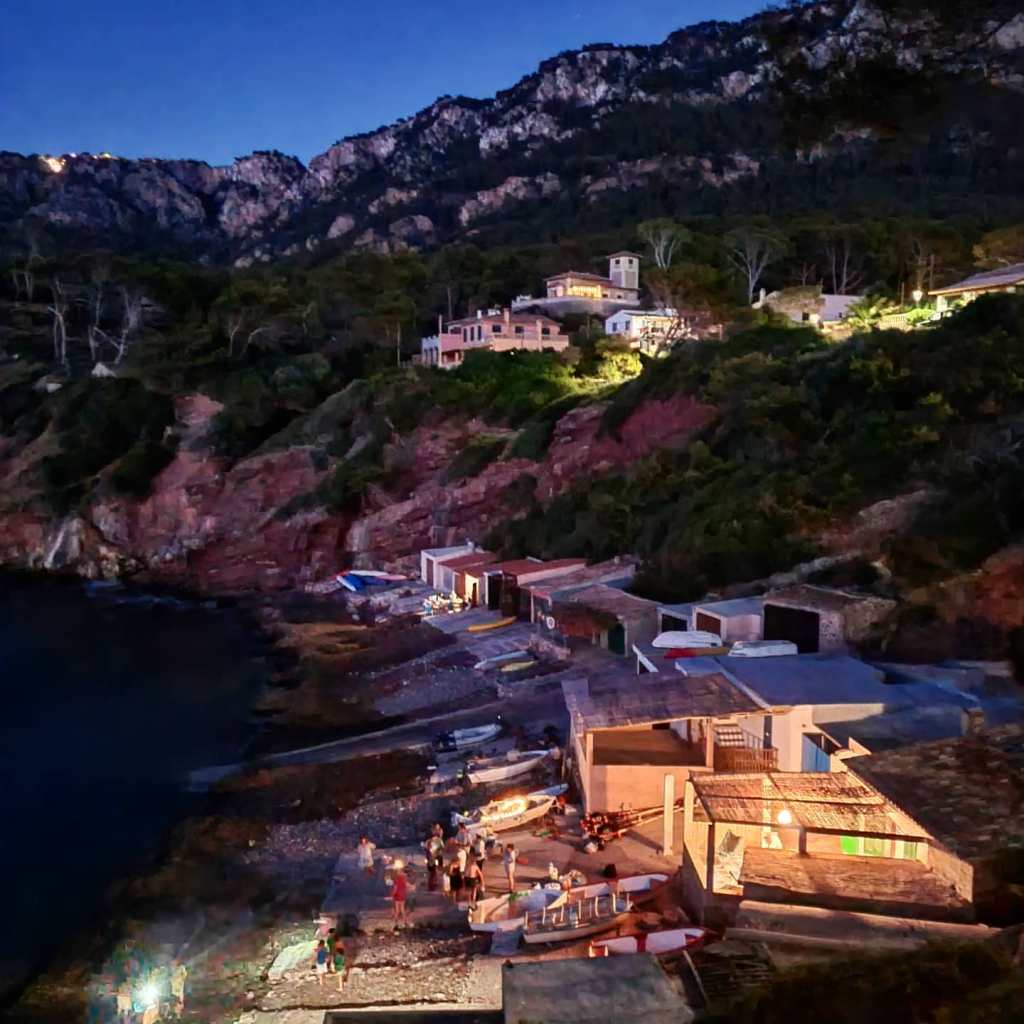
From our house in Port D’Es Canonge it is a five minute walk to the little semi-circular cove, with dinghies pulled up on one side and a row of boathouses lining the rear of the beach. From here the wild rocky beach of Platja de Son Bunyola is ten minutes walk to one side, with the even wilder beach of Es Berganti fifteen minutes’ walk the other way, at the foot of a spectacular cliff. Most evenings a fierce katabatic wind appears without warning and whips around the trees and houses for half an hour before disappearing as suddenly as it came. Other than this wind and the ever-present cigales, the most prominent sound in the evening is the laughter and cries of Mallorquin children playing in the street.

After a month in Port D’Es Canonge, at the start of August we moved eight kilometres inland to a terraced house in the village of Esporles, high in the Tramuntana mountains. We appreciated the luxury of having shops and restaurants within walking distance, and being excused the ordeal of Port D’Es Canonges’ four kilometres of single-track road carved into the mountainside, with its horrendous sequence of twenty-nine hairpin bends.

Our house in Esporles

However there is something magical about Port D’Es Canonge and despite its inconveniences we both miss it. Therefore on Monday we are packing our bags once again and moving back to Port D’Es Canonge, where we will remain until the end of September. After that the picture is hard to predict.

In 2001, as a citizen of the European Union, I was free to rent a house on Stromboli and stay for as long as I wanted. However in 2021 the situation is somewhat different. As a citizen of the United Kingdom, beyond the end of the Transition Period on 31st December 2020, I cannot remain in Spain more than three months without a visa.

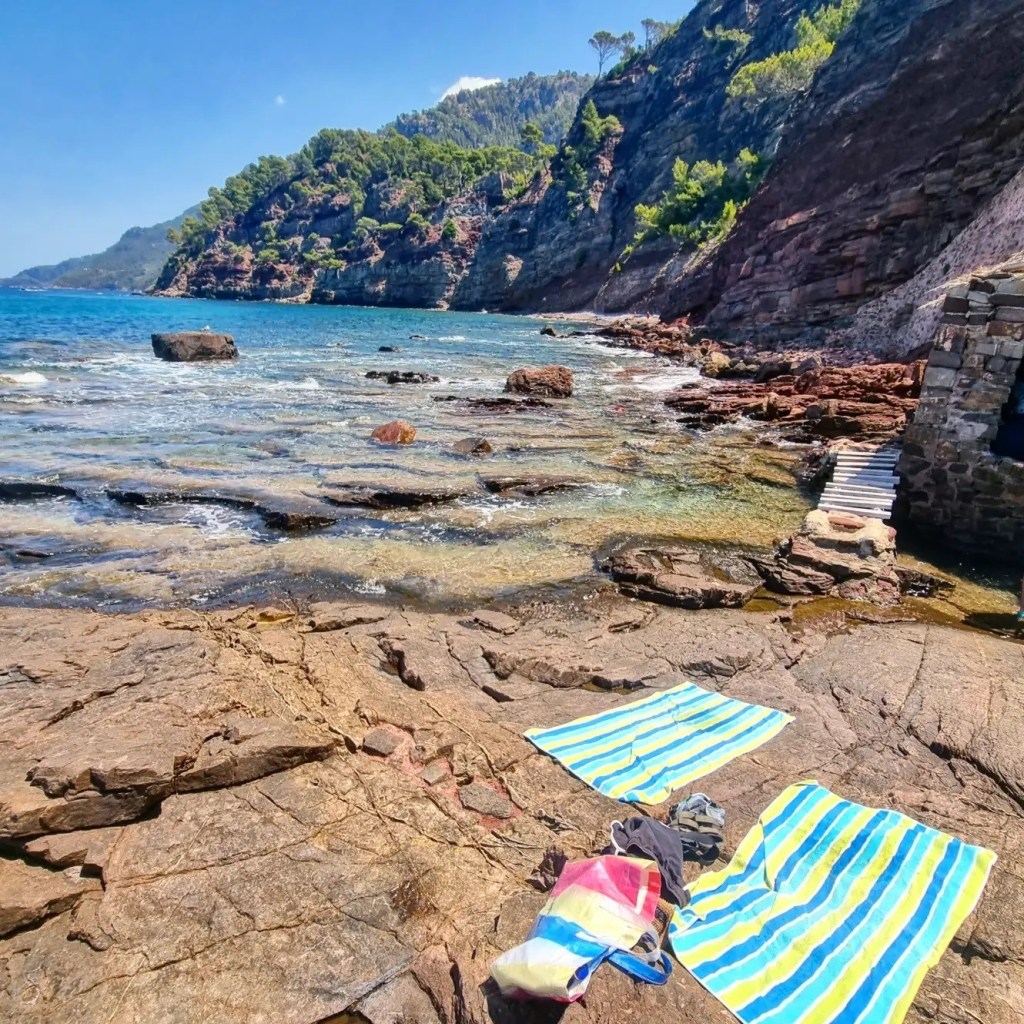
Es Berganti, our favourite swimming spot,

When I researched the process last year it seemed straightforward so I gave it little thought. But when we arrived and I commenced the process to apply for an “Entrepreneur Visa”, the proverbial rabbit hole opened at my feet.

At this point I have had to obtain a document from the UK police stating I have no criminal record, get the document stamped with a “Hague Apostille”, get the stamped document translated into Spanish, get the translation stamped as well, request a certified copy of my degree certificate from Cambridge University, provide all my payslips for the past two years, get an official letter from The Trampery stating that I am an employee, provide a complete business plan for the project, provide a certificate proving I have purchased health insurance, submit photocopies of every page in my passport. As a passably intelligent English speaker there is no possibility I could have completed the process unaided. Alejandro has been heroic, but even for him as a native Spanish-speaker it has been an ordeal.

The greatest challenge was getting an appointment with the Spanish Consulate in London. By default every email to the contact address they provide is met with a lengthy and impenetrable automated message, explaining that the Consulate is not willing to reply to any question whose answer can potentially be found somewhere on the internet.

The harbour at Port D’Es Canonge

I would probably have given up after receiving this message three times, but fortunately Alejandro was cunning enough to apply for a different document, which elicited a human response, so he could then plead with them for an appointment, which has now been scheduled for 27th August.

If the Spanish Government doesn’t grant me an Entrepreneur Visa, we’ll come back to London at the end of September and work out a different route. The whole experience has been a bit disheartening, and drives home the appalling cost of the British population’s decision to leave the European Union. But despite the vicissitudes of the visa process, we feel privileged to be here and I haven’t regretted our decision for a micro-second.

: c :

t r a n s i t i o n

[ 17:11 Thursday 15 July 2021 – Port D’Es Canonge, Mallorca ]

On the first of July, Alejandro and I arrived on the island of Mallorca with ten suitcases and two bicycles. After eighteen years in London, it’s time for a new adventure. We plan to stay here a year, possibly longer.

I’m writing now from the terrace of a house in Port D’Es Canonge, a tiny and inaccessible village on the island’s rocky north coast, where the air is filled with birdsong and the afternoon sun hangs drowsy in the sky. We’ll spend our first month here, whilst we hunt for somewhere to rent for the rest of the year.

Our house for July in Port D’Es Canonge

Our arrival in Mallorca was the culmination of a six-month marathon, involving the reorganisation of almost every aspect of our lives. It started in December 2019 when we were given six months’ notice to leave Old Ford Lock, my home in London since 2013. It was a heavy blow, but it prompted us to think about what our next step could be.

For several years a plan had been gestating in The Trampery to establish a rural workspace somewhere in the Mediterranean. Faced with the loss of our London home, Alejandro and I decided to move away and try to realise the project. The experience of the corona lockdown demonstrated I can do most of what I need to do to run The Trampery remotely; via email, phone and video conference. However I still need to attend occasional site visits and meetings face-to-face, so a continuing base in London was vital.

After circling through various ideas, the option we settled on was to rent a house in the Mediterranean, and buy a boat as our London base. Meanwhile having assessed several Mediterranean destinations for The Trampery project, Mallorca emerged as the most promising location. The clock was ticking. We had six months to close up Old Ford Lock, put our belongings into storage, buy a boat and find somewhere to live in Mallorca.

Therefore in the second week of January we started going to visit boats that were up for sale. At first we focused on widebeam canal boats. Then we started looking at Dutch barge conversions. Finally (with a nudge from my father) we progressed to motor yachts, which seemed to be more spacious, lighter, less maintenance-hungry, and more fun on the water.

None of the boats we looked at in London were suitable, so we expanded the search and started visiting boats on the upper Thames; then the River Roach and the River Crouch. When we still didn’t find anything we liked, we broadened the search further to include the whole of Southern and Eastern England.

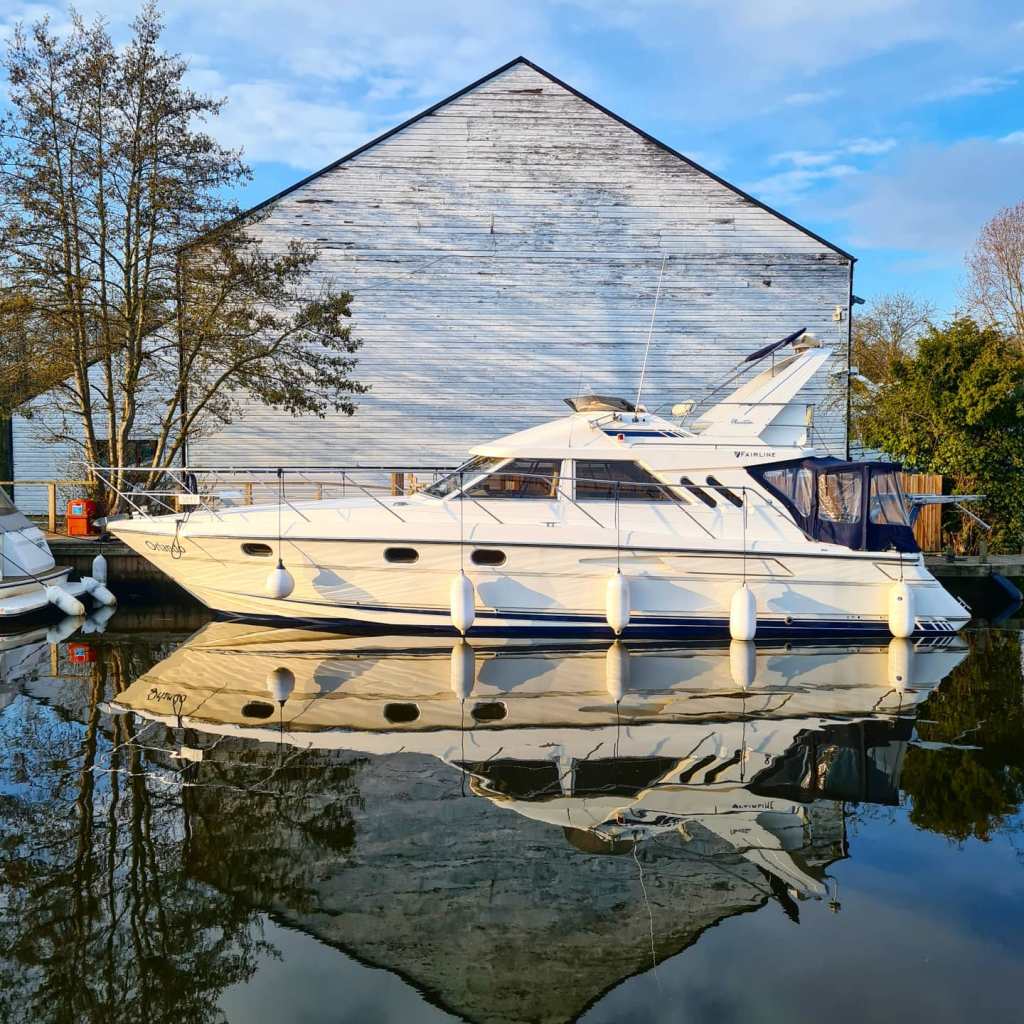
On 17th March I took the train to Brundall in Norfolk to look at two boats on the river Yare. The first had 2,000 hours on the engines and looked absolutely clapped out. However the second was exquisite, on a different level from anything I’d seen previously. The boat was a Fairline 41/43, built in 1991 in Oundle, powered by a pair of 375 horse-power Caterpillar diesels.

It had a spacious saloon with seating for seven, two comfortable cabins, a well-equipped galley, plus outdoor seating in the cockpit and flying bridge. It was evident that throughout the boat’s thirty-year life, each of its owners had lovingly maintained it, whilst investing in a string of upgrades. These included top-of-the-range navigation technology, a powerful heating system for the winter and an excellent sound system. The boat was beautifully built, with a light oak interior and lots of 90s design touches. Back in London that evening I went through the photos with Alejandro. He thought it was perfect. The next day we made an offer, and by the end of the day it had been accepted.

Orlando, our 1991 Fairline 41/43

Now began a hectic burst of activity. I sought recommendations for local boat surveyors; got quotes; engaged one; organised for the boat to be lifted out of the water; scheduled a trial run on the river. The surveyor’s report gave the boat a clean bill of health. On 15th April I transferred the remaining payment and the boat was ours.

This triggered a second burst of activity. I sought recommendations for an engineer to install a holding tank; got quotes; engaged one; organised for the boat to be lifted out of the water again, so the hull could be painted with anti-fouling; ordered a new anchor chain, after a byzantine process to establish what variety would fit the windlass. Meanwhile Alejandro and I assembled a list of 80 possible names before settling on “Orlando”.

Owning a boat wasn’t going to be much use unless we had somewhere to moor it. Alejandro and I systematically visited every dock, marina and pontoon within spitting distance of London. The one we picked was St Katharine Docks. Constructed by Thomas Telford in 1828, this was London’s most central commercial dock, until its closure in 1968. Then in the 1980s it was redeveloped as an urban marina, surrounded by restaurants, shops, offices and housing.

St Kats’ location next to Tower Bridge and the Tower of London, with the City’s towers looming above it, has an air of unreality. However bearing in mind its central location, the dock itself it is a haven of tranquility. Normally there’s a waiting list of years to get a berth, but because of the corona pandemic several people had shifted their boats away from London, and to our amazement a couple of slots were available. We grabbed one before the situation changed.

The next task was to bring Orlando down from Brundall to London. This would involve a first leg through the Norfolk Broads, a second leg down the North Sea then a third leg up the Thames Estuary. I bought the relevant charts and pilot books and started studying them. However it soon appeared this might all be in vain.

There are only two points where one can exit the Norfolk Broads and get out to sea: at Great Yarmouth and Lowestoft. Each route involves opening a swing-bridge that carries the railway line, allowing boat traffic to pass. However when I called the Broads Authority to make the necessary arrangements, they informed me both railway bridges were currently out of commission for repairs, and it might be six months before they were operational again. They were very apologetic, but said the only way I could get Orlando to London would be transporting it by road!

Fortunately at this point I was introduced to someone who’d been boating in Lowestoft all their life. They asked me how high the boat was, pondered my answer a few seconds, then said we might be able to squeeze under the railway bridge without opening it, so long as we timed it exactly at low tide. There was no guarantee this would work, but it seemed like our best shot to get Orlando to London, so we decided to give it a try.

On 15th May I cast off the lines at Brundall and set off down the River Yare, accompanied by my friend Sara, an expert sailor. We had a few hairy moments, provoked by my total inexperience with twin-prop motor vessels, but thankfully we managed to avoid doing too much damage. At 3.30pm we reached Oulton Broad where we tied up and waited for the lock. At 4.30pm we passed the lock, our Lowestoft skipper came aboard, and we tied up again to wait for low tide.

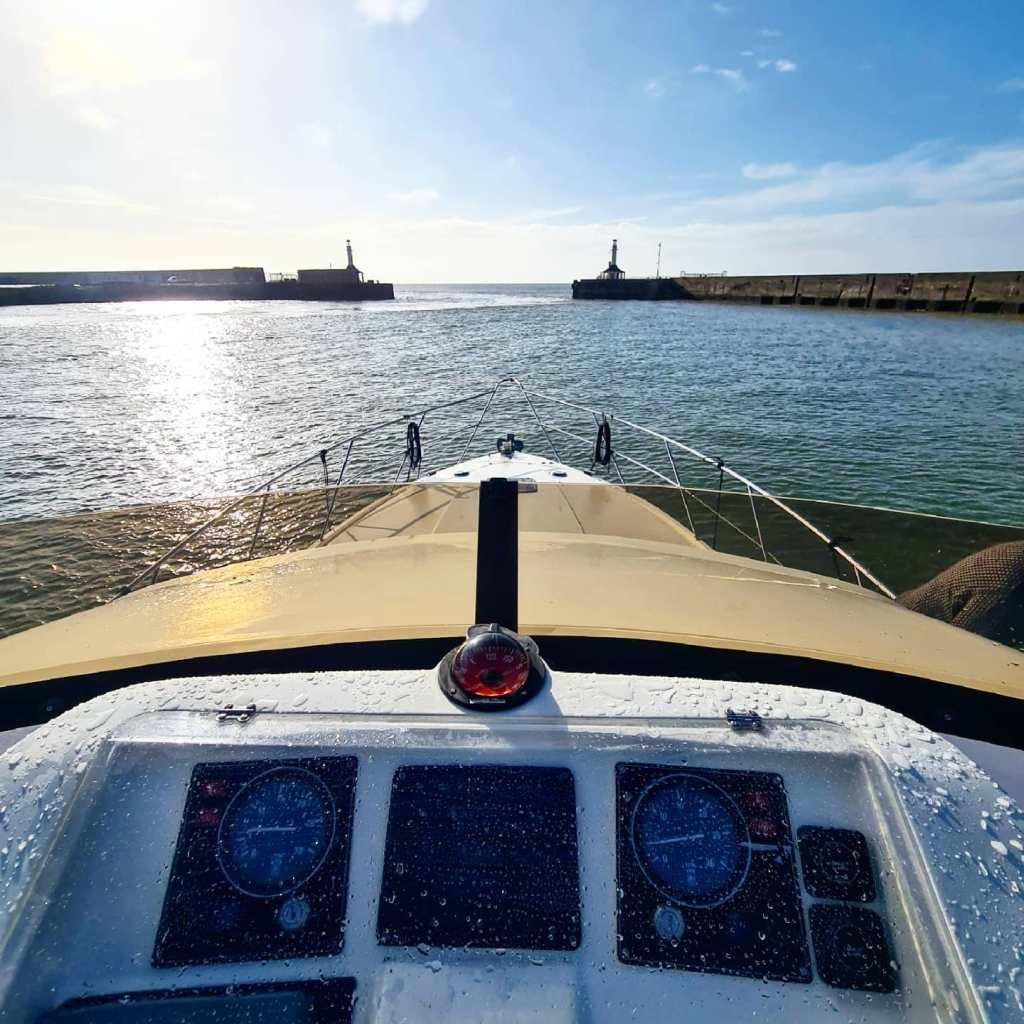
At 6pm we judged the tide was as low as it was going to get, untied and started creeping towards the railway bridge as slowly as possible. Initially it wasn’t clear whether we’d make it, but as the radar mast came up to the bridge there was 20cm of clearance. Everyone heaved a huge sigh of relief as we passed under the railway lines and out the other side. We carried on through Lowestoft harbour, then moored at the Royal Norfolk and Suffolk Sailing Club overnight.

The next morning we pulled out of Lowestoft at 7am with a clear sky and a calm sea, dodging a flock of maintenance boats heading out to service the North Sea wind farms. It was my first chance to open up Orlando’s throttles. As we passed fifteen knots the hull lifted in the water and we began to plane across the waves. Twenty knots, twenty-five knots, twenty-eight knots. I set the autopilot and started checking that everything was working correctly.

Leaving Lowestoft harbour

The passage down the coast and up the Thames Estuary was one of the most exhilarating experiences of my life. The boat performed magnificently. At 4pm, an hour ahead of schedule, we reached Tower Bridge and the lock gates opened to welcome us into St Katharine Docks. Half an hour later we were tied up on the berth. The first piece of the jigsaw was in place.

The next task was to make a dramatic reduction in my household belongings. Towards the end of May I started photographing bits of furniture and listing them on eBay. Over the following month I managed to sell a five-seater sofa, a three-seater sofabed, an enormous handmade Persian rug, a set of four Danish mid-century dining chairs, a set of six English mid-century dining chairs, a pair of oak carver chairs, a pair of oak wheel-back chairs, a pair of wicker armchairs, a teak extending dining table, a Victorian mahogany chest of drawers and an Edwardian inlaid chest of drawers. With a heavy heart, I also sold the Yamaha upright piano which had been my daily companion for thirteen years.

Alongside the eBay listings, Alejandro and I started giving away anything that wasn’t saleable for free in the Hackney Wick community, and throwing away sacks and sacks of stuff that nobody would want. I went through all my clothes and donated half of them to a charity shop.

As well as reducing our belongings, we also needed to organise somewhere to store what remained. Alejandro researched hundreds of storage units across London and South-East England, finally settling on a business in Romford. At the start of June we began packing everything that was left in the house into cardboard boxes, piling them up around the house like geological formations.

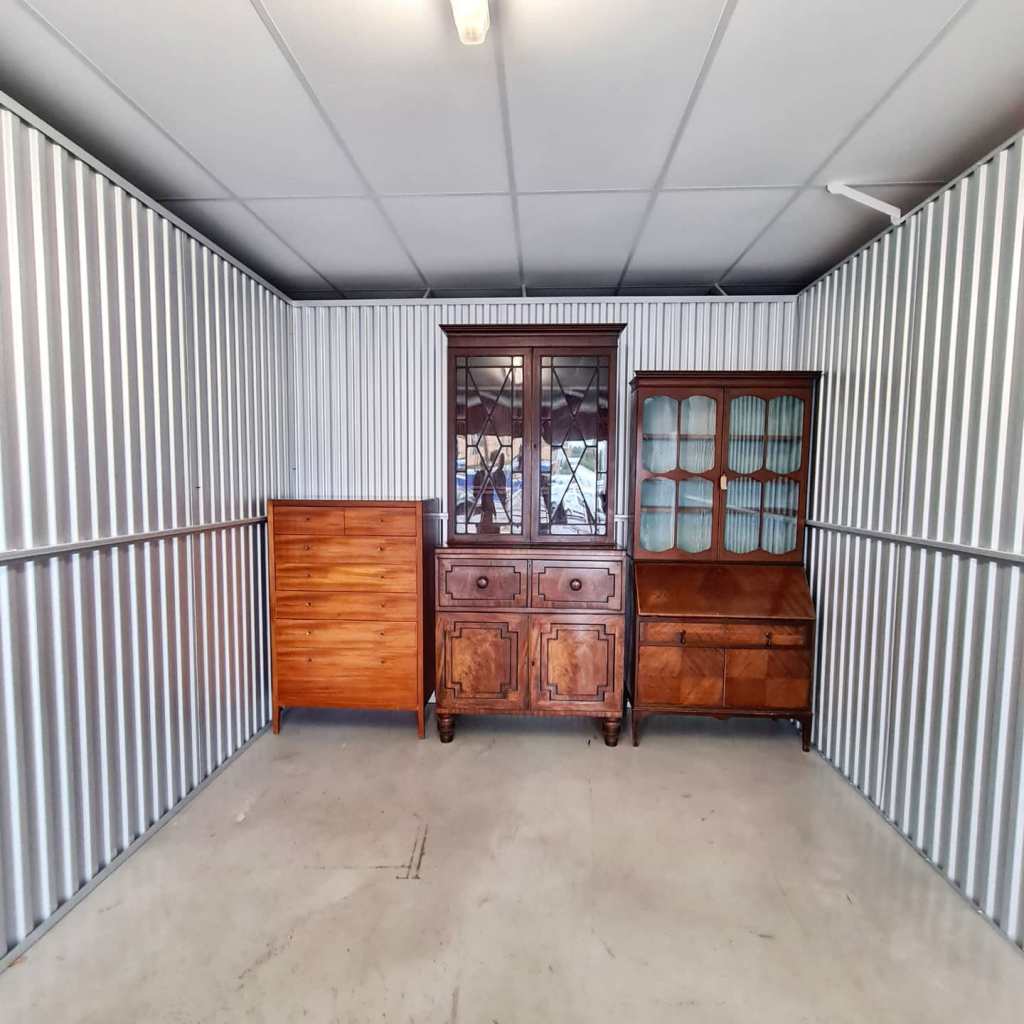
The first items arrive in our Romford storage unit

On 20th June two Brazilian movers took the largest items of furniture along with our books and pictures to the unit in Romford. Then on 27th June a team of three Pakistani movers took everything else, and to our immense relief managed to squeeze it all in. The second piece of the jigsaw was in place.

On 29th June we took a van with variety of clothes, kitchen equipment and books to Orlando in preparation for it to become our London home. On 30th June Alejandro and I handed over the keys to Old Ford Lock and closed the towpath gate for the final time, concluding this stage of our lives. I walked down the towpath without looking back.

We took a taxi to St Katharine Docks in silence, both lost in our thoughts. The rest of the afternoon was spent finding places to stow everything on the boat. That night we went to sleep on Orlando, for the first time as our London home.

At 4am on 1st July 2021 we woke up and set off with our cases for the airport. A new adventure was beginning.

: c :